Abstract :
[en] STRESS AND SALIVA : BIOMARKER QUANTIFICATION AND METABONOMIC PROFILING
G. Romoaldo1,2, S. Hambye2, V. Tagliatti1, J-M. Colet1, B. Blankert2
1 Laboratory of Human Biology and toxicity, Faculty of Medicine and Pharmacy, UMons
2 Laboratory of Pharmaceutical Analysis, Faculty of Medicine and Pharmacy, UMons,
Research Institute for Health Sciences and Technology, Place du Parc 20, 7000 Mons,
Belgium.
Different biomarkers used for assessing emotional states of individuals are documented in the
literature.
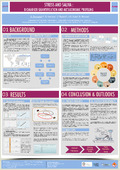
Our study aims to monitor stress, cognitive (over)load and mental fatigue using non-invasive
techniques. We consider the quantification of biomarkers, in particular free 3-Methoxy-4-
hydroxyphenylglycol (MHPG) a Norepinephrine metabolite which salivary levels are directly
correlated to plasma concentration and linked to different emotional states[1].
Recurrently, electrochemical detection (ECD) methods remain the first choice for
catecholamines quantification. As a matter of fact, due to electroactive properties of these
molecules, ECD offers a high sensitivity and selectivity when operating at physiological
concentrations (ng/mL)[2].
The quantification of MHPG is operated using amperometric and fluorescence detection (FLR)
coupled to UPLC separation. We assessed different kinds of column chemistries guiding to
the best separation resolution of polar compounds found in oral fluid. We also compared
several sample preparation methods to clean up the matrix and concentrate our analyte (SPE
and SLE).
We developed a rapid and sensitive method for salivary free MHPG quantification with a LOQ
of 7,2ng/mL and 6,4 ng/mL for ECD and FLR respectively on a 5-75 ng/mL linearity range.
Physiological average concentrations are 12,4ng/mL for men and 13,5ng/mL for women.[3,4]
In parallel, we performed metabonomic profiling studies using 1HNMR spectra of saliva
samples, to assess the correlation between the fluctuation of emotional states and the
variability of metabolites content of this biofluid. Samples were collected from subjects
submitted to Trier Social Stress Test protocol to induce a psychosocial stress.
We applied multivariate analysis (Principal Component Analysis and Partial Least Square
Discriminant Analysis) to compare subject's profiles evolution before and after the test.
Preliminary results showed a variation of the metabonomics profiles after the stress step of the
test with a back to initial profile trend following the 30 minutes resting step.
We present here a double approach for emotional states assessment comprising a targeted
method operating biomarker quantification and, in another hand, a metabonomic profiling based
non-targeted method.
References
[1] : R.-K. Yang et al. In Biol. Psychiatry, vol. 42, no. 9, pp. 821-826, Nov. 1997.
[2] : W.J. Cubala et al. In Journal of affective disorders 161, pp. 4-7, March 2014.
[3] : S. Yamada et al. Psychiatry Research pp. 217-223, 2000
[4] : Li et al. Biological psychology 73, 209-211, 2006
Commentary :
[2] : W.J. Cubala et al. In Journal of affective disorders 161, pp. 4-7, March 2014.
[1] : R.-K. Yang et al. In Biol. Psychiatry, vol. 42, no. 9, pp. 821-826, Nov. 1997.