Abstract :
[en] Keywords: supercooling, solidification, water, superhydrophobic surface, droplet
Water is one of the most important element on earth. For scientists, it's a source of fascination for years because water has a lot of strange properties. For example, cold liquid water is less viscous but the density increases (maximum at 4°C).
At the beginning of the 18th century, D.G. Fahrenheit showed that a liquid can be in a state called su-percooling: the liquid stays liquid even below his temperature of solidification. Nowadays, this par-ticular property is a hot topic because supercooled drops can cause a lot of troubles due to icing. Re-cently, high speed imaging enabled large progress in research [1].
In high altitude, clouds present many liquid drops which are in supercooled conditions. This water is in a metastable state: an appropriate trigger can provoke its fast transition to a thermodynamically more stable state, ice [2]. It's an important problem for aeronautics because when a plane penetrates in such a cloud full of supercooled droplets, ice accretion starts to form on the wings changing their aerody-namic properties, or icing on other plane parts (Pitot tube for example). Nowadays, the solutions are either using chemical products to decrease the temperature of solidification and/or using heating at the forefront of the wings and prevent icing. Nevertheless, these solutions are not ecological neither inex-pensive.
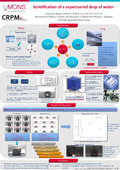
In this work, we concentrated our researches on supercooled droplets. We built a freezing box to de-crease the temperature of the droplet below the temperature of solidification of water. We triggered these drop and recorded with a high speed camera the fast phase transition. We showed the relation between the speed of ice front and the temperature of water but also with the size of the drop. We vis-ualized two different solidification fronts in the drop : the first makes the transition to a material which looks like melted ice (soft material) and the second one presents the transition towards ice (hard mate-rial).
In figure 1, we can see the propagation of the ice front in the supercooled drop. We touch the super-cooled drop and we see a front which quickly comes down (the optical properties of the drop change during the phase transition).