amines; CO2 revalorization; CO2-based cyclic carbonates; non isocyanate polyurethanes; supercritical CO2; CO2-based cyclic carbonate; Cyclic carbonates; Energy efficient; Foam production; Nonisocyanate polyurethane; Polyurethane Foam; Revalorization; Shape-memory; Supercritical CO 2; Process Chemistry and Technology; Polymers and Plastics; Organic Chemistry
Abstract :
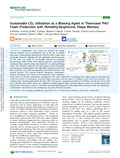
[en] Polyurethane (PU) foams are essential for energy-efficient insulation but are problematic due to the use of harmful isocyanates. Nonisocyanate polyurethanes (NIPUs) offer a safer, more sustainable alternative, aligning with EU regulations and climate goals. In this work, we report an eco-friendly method for producing thermosetting NIPU foams with tailored properties and humidity-responsive shape memory using supercritical CO2 as a physical blowing agent. This innovative approach not only replaces current flammable, greenhouse-gas-emitting agents with high global warming potential but also revalorizes CO2 in the manufacturing and synthesis process. The method involves CO2 pressure-induced absorption, temperature-induced desorption, and curing of five-membered cyclic carbonate/amine resins. At elevated temperatures, simultaneous CO2 release and NIPU cross-linking drive cellular structure formation. We studied the effects of curing agents, foaming/curing temperatures, and the impact of stabilizers on the final foam properties. The resulting foams demonstrated tunable densities (270-451 kg/m3), compression moduli (16-350 kPa), and cell sizes (0.33-0.99 mm). Notably, these NIPU foams also exhibited humidity-triggered shape memory behavior, which can greatly expand their functionality. This process ensures a controlled and sustainable approach to fabricating NIPU thermoset foams and represents a transformative step forward in the development of greener PU-based materials.
Research center :
CIRMAP - Centre d'Innovation et de Recherche en Matériaux Polymères
Disciplines :
Materials science & engineering
Author, co-author :
Gouveia, Katherine ; Laboratory of Polymeric and Composite Materials (LPCM), University of Mons, Mons, Belgium ; ICGM, ENSCM, CNRS, University of Montpellier, Montpellier, France
Vauloup, Joshua; ICGM, ENSCM, CNRS, University of Montpellier, Montpellier, France
Colpaert, Maxime; ICGM, ENSCM, CNRS, University of Montpellier, Montpellier, France
Ocando, Connie ; Laboratory of Polymeric and Composite Materials (LPCM), University of Mons, Mons, Belgium
Lacroix-Desmazes, Patrick ; ICGM, ENSCM, CNRS, University of Montpellier, Montpellier, France
Ladmiral, Vincent ; ICGM, ENSCM, CNRS, University of Montpellier, Montpellier, France
Caillol, Sylvain ; ICGM, ENSCM, CNRS, University of Montpellier, Montpellier, France
Raquez, Jean-Marie ; Université de Mons - UMONS > Faculté des Sciences > Service des Matériaux Polymères et Composites
Language :
English
Title :
Sustainable CO2 Utilization as a Blowing Agent in Thermoset PHU Foam Production with Humidity-Responsive Shape Memory
R400 - Institut de Recherche en Science et Ingénierie des Matériaux
Funders :
H2020 Marie Sklodowska-Curie Actions NIPU-EJD project
Funding text :
The authors would like to thank the financial support provided by the NIPU-EJD project. This project has received funding from the research and innovation program in the frame of European Union\u2019s Horizon 2022 under the Marie Sk\u0142odowska-Curie grant agreement No. 955700 (NIPU-EJD project). J,-M.R. is an FRS-FNRS Research Director and a WET-T investigator under the FRS-FNRS auspices.
Engels, H. W. Polyurethanes: Versatile materials and sustainable problem solvers for today’s challenges. Angew. Chemie - Int. Ed. 2013, 52, 9422- 9441, 10.1002/anie.201302766
Szycher, M. Szycher’s handbook of polyurethanes; CRC press, 1999.
Fraleoni-Morgera, A.; Afshani, M.; Montelpare, S.; Lops, C. Sustainable Micro- and Nanocomposites for Thermal Insulation in Buildings. Adv. Eng. Mater. 2023, 26, 2301064 10.1002/adem.202301064
Gama, N. V.; Ferreira, A.; Barros-Timmons, A. Polyurethane foams: Past, present, and future. Materials (Basel) 2018, 11, 1841, 10.3390/ma11101841
Peyrton, J.; Avérous, L. Structure-properties relationships of cellular materials from biobased polyurethane foams. Mater. Sci. Eng. R Rep. 2021, 145, 100608 10.1016/j.mser.2021.100608
Singh, S. N. Blowing agents for polyurethanes; Rapra Technology, 2002.
Niaounakis, M. Chapter 9 - Foaming and Foamed Products. in Biopolymers: Processing and Products. ed., Niaounakis, M.; William Andrew Publishing, 2015, 327- 359.
Climate change: what the EU is doing, 2024. https://www.consilium.europa.eu/en/policies/climate-change/.
Cornille, A.; Auvergne, R.; Figovsky, O.; Boutevin, B.; Caillol, S. A perspective approach to sustainable routes for non-isocyanate polyurethanes. Eur. Polym. J. 2017, 87, 535- 552, 10.1016/j.eurpolymj.2016.11.027
Cornille, A.; Dworakowska, S.; Bogdal, D.; Boutevin, B.; Caillol, S. A new way of creating cellular polyurethane materials: NIPU foams. Eur. Polym. J. 2015, 66, 129- 138, 10.1016/j.eurpolymj.2015.01.034
Cornille, A. Room temperature flexible isocyanate-free polyurethane foams. Eur. Polym. J. 2016, 84, 873- 888, 10.1016/j.eurpolymj.2016.05.032
Coste, G.; Berne, D.; Ladmiral, V.; Negrell, C.; Caillol, S. Non-isocyanate polyurethane foams based on six-membered cyclic carbonates ☆. Eur. Polym. J. 2022, 176, 111392 10.1016/j.eurpolymj.2022.111392
Monie, F. Chemo- and Regioselective Additions of Nucleophiles to Cyclic Carbonates for the Preparation of Self-Blowing Non-Isocyanate Polyurethane Foams. Angew. Chem. 2020, 132, 17181- 17189, 10.1002/ange.202006267
Bourguignon, M.; Grignard, B.; Detrembleur, C. Water-Induced Self-Blown Non-Isocyanate Polyurethane Foams. Angew. Chem., -Int. Ed. 2022, 61, e202213422 10.1002/anie.202213422
Gunasekaran, H. B. Rapid Carbon Dioxide Foaming of 3D Printed Thermoplastic Polyurethane Elastomers. ACS Appl. Polym. Mater. 2022, 4, 1497- 1511, 10.1021/acsapm.1c01846
Belmonte, P. Transformation of TPU elastomers into TPU foams using supercritical CO2. A new reprocessing approach. J. Supercrit. Fluids 2023, 192, 105806 10.1016/j.supflu.2022.105806
Wang, G. Structure-tunable thermoplastic polyurethane foams fabricated by supercritical carbon dioxide foaming and their compressive mechanical properties. J. Supercrit. Fluids 2019, 149, 127- 137, 10.1016/j.supflu.2019.04.004
Villamil Jiménez, J. A. Foaming of PLA composites by supercritical fluid-assisted processes: A review. Molecules 2020, 25, 3408, 10.3390/molecules25153408
Nalawade, S. P.; Picchioni, F.; Janssen, L. P. B. M. Supercritical carbon dioxide as a green solvent for processing polymer melts: Processing aspects and applications. Prog. Polym. Sci. 2006, 31, 19- 43, 10.1016/j.progpolymsci.2005.08.002
Tomasko, D. L. A Review of CO2 Applications in the Processing of Polymers. Ind. Eng. Chem. Res. 2003, 42, 6431- 6456, 10.1021/ie030199z
Grignard, B. CO2-blown microcellular non-isocyanate polyurethane (NIPU) foams: From bio- and CO2-sourced monomers to potentially thermal insulating materials. Green Chem. 2016, 18, 2206- 2215, 10.1039/C5GC02723C
Lemmon, E. W.; Bell, I. H.; Huber, M. L.; McLinden, M. O. Thermophysical Properties of Fluid Systems. in NIST Chemistry WebBook. eds., Linstrom, P. J.; Mallard, W. G.; National Institute of Standards and Technology (NIST)).
Coste, G.; Negrell, C.; Caillol, S. Cascade (Dithio)carbonate Ring Opening Reactions for Self-Blowing Polyhydroxythiourethane Foams. Macromol. Rapid Commun. 2022, 10.1002/marc.202100833
Choong, P. S.; Hui, Y. L. E.; Lim, C. C. CO2-Blown Nonisocyanate Polyurethane Foams. ACS Macro Lett. 2023, 12, 1094- 1099, 10.1021/acsmacrolett.3c00334
Bacsik, Z. Mechanisms and kinetics for sorption of CO 2 on bicontinuous mesoporous silica modified with n-propylamine. Langmuir 2011, 27, 11118- 11128, 10.1021/la202033p
Didas, S. A.; Sakwa-Novak, M. A.; Foo, G. S.; Sievers, C.; Jones, C. W. Effect of amine surface coverage on the Co-adsorption of CO2 and water: Spectral deconvolution of adsorbed species. J. Phys. Chem. Lett. 2014, 5, 4194- 4200, 10.1021/jz502032c
Bose, M.; Nam, P. Role of additives in fabrication of soy-based rigid polyurethane foam for structural and thermal insulation applications. J. Appl. Polym. Sci. 2021, 138, 51325 10.1002/app.51325
Monie, F.; Grignard, B.; Detrembleur, C. Divergent Aminolysis Approach for Constructing Recyclable Self-Blown Nonisocyanate Polyurethane Foams. ACS Macro Lett. 2022, 11, 236- 242, 10.1021/acsmacrolett.1c00793
Pronoitis, C.; Hakkarainen, M.; Odelius, K. Structurally Diverse and Recyclable Isocyanate-Free Polyurethane Networks from CO2-Derived Cyclic Carbonates. ACS Sustainable Chem. Eng. 2022, 10, 2522- 2531, 10.1021/acssuschemeng.1c08530
Blattmann, H.; Lauth, M.; Mülhaupt, R. Flexible and Bio-Based Nonisocyanate Polyurethane (NIPU) Foams. Macromol. Mater. Eng. 2016, 301, 944- 952, 10.1002/mame.201600141
Leng, J.; Lu, H.; Liu, Y.; Huang, W. M.; Du, S. Shape-memory polymers - A class of novel smart materials. MRS Bull. 2009, 34, 848- 855, 10.1557/mrs2009.235
Huang, W. M. Shape memory materials. Mater. Today 2010, 13, 54- 61, 10.1016/S1369-7021(10)70128-0
Sessini, V.; Arrieta, M. P.; Fernández-torres, A.; Peponi, L. Humidity-activated shape memory e ff ect on plasticized starch-based biomaterials. Carbohydr.Polym. 2018, 179, 93- 99, 10.1016/j.carbpol.2017.09.070
Sessini, V. Humidity-Activated Shape Memory Effects on Thermoplastic Starch/EVA Blends and Their Compatibilized Nanocomposites. Macromol. Chem. Phys. 2017, 218, 1700388 10.1002/macp.201700388