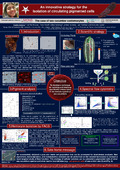
[en] The immune system of sea cucumbers, which are marine invertebrates belonging to
the phylum Echinodermata, relies on circulating cells known as coelomocytes. These
cells are found in the fluids of the coelomic cavity and the ambulacral system of these
organisms. In some sea cucumber species, hemocytes are the predominant type of
coelomocytes in the ambulacral fluid and are stored in large numbers in an organ of
this system, the Polian vesicle. Hemocytes have been recently studied for their role in
encapsulating foreign particles. Interestingly, they are easily distinguishable from other
coelomocytes due to their intense red color. It has long been assumed that this
pigmentation was due to the presence of hemoglobin. However, our pigment analysis
using HPLC revealed a high concentration of carotenoids in the ambulacral fluid and
Polian vesicle, suggesting that these pigments are responsible for the hemocyte
pigmentation. Additionally, hemocytes exhibit strong autofluorescence. In this study,
we used a combined approach of spectral flow cytometry and FACS to isolate
hemocytes by taking advantage of their autofluorescence. We successfully obtained a
pure and viable cell population that can be processed for downstream analyses. This
strategy could be extended to other pigmented cells and offer new perspectives for a
more targeted study of hemocytes and their function(s) in the immune response of sea
cucumbers.
Disciplines :
Aquatic sciences & oceanology
Author, co-author :
Bossiroy, Estelle ; Université de Mons - UMONS > Faculté des Sciences > Service de Biologie des Organismes Marins et Biomimétisme
Wambreuse, Noé ; Université de Mons - UMONS > Faculté des Sciences > Service de Biologie des Organismes Marins et Biomimétisme
David, Frank; Station Marine de Concarneau > Museum National d’Histoire Naturelle (MNHN)
Vanwinge, Céline; GIGA Research Institute of University of Liège > Flow Cytometry Platform
Delroisse, Jérôme ✱; Université de Mons - UMONS > Faculté des Sciences > Service de Biologie des Organismes Marins et Biomimétisme
Eeckhaut, Igor ✱; Université de Mons - UMONS > Faculté des Sciences > Service de Biologie des Organismes Marins et Biomimétisme
Caulier, Guillaume ✱; Université de Mons - UMONS > Faculté des Sciences > Service de Biologie des Organismes Marins et Biomimétisme
✱ These authors have contributed equally to this work.
Language :
English
Title :
An innovative strategy for the isolation of circulating pigmented cells: the case of sea cucumber coelomocytes
Alternative titles :
[fr] Une stratégie innovante pour l’isolement des cellules pigmentées circulantes : le cas des cœlomocytes de concombre de mer
Publication date :
30 May 2023
Event name :
Zoology 2023, Evolution, development, and plasticity in a changing world: celebrating 150 years of zoology in the Netherlands
Event organizer :
Koninklijke Nederlandse Dierkundige Vereniging Lieu de la manifestation :
Event place :
Leiden, Netherlands
Event date :
30 mai 2023
Audience :
International
Peer review/Selection committee :
Editorial reviewed
Research unit :
S864 - Biologie des Organismes Marins et Biomimétisme