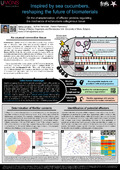
[en] In recent years, smart materials such as soft actuators have been the subject of extensive research in the medical and robotics fields for their controlled and predictable response to external stimuli. Among the various biological sources of inspiration considered for those applications, the mutable collagenous tissue (MCT) of echinoderms stands out as a promising candidate due to its intrinsic ability to rapidly and reversibly alter its mechanical properties. MCT is a specialized form of connective tissue found exclusively in the phylum Echinodermata (sea cucumbers, sea urchins, sea stars, brittle stars and sea lilies) as an energy-efficient posture maintenance structure for various behaviors. MCT is characterized by its capacity to transition between states of varying stiffness under neural control. The transition is mediated by changes in the interfibrillar cohesion within collagen through the secretion of effector proteins known as stiffeners or softeners. The conceptual framework of the MCT proposes that mechanical transitions are regulated by at least two pairs of antagonistic proteins, with additional components contributing to structural cohesion. Although MCT has been the center of extensive research in the last 50 years, much remains to be understood about the nature and activity of effector proteins, particularly across the phylum. To this end, proteomic and interactomic data have been collected from the dermis of the European sea cucumber Holothuria forskali and were analyzed by in silico and in vitro methods to identify novel and previously described effector proteins.