Abstract :
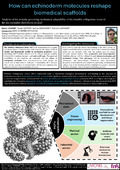
[en] Echinoderms, the phylum encompassing sea lilies, sea stars, brittle stars, sea urchins, and sea cucumbers, exhibit a unique connective tissue that defies the typical rules observed in other animals. This tissue, known as Mutable Collagenous Tissue (MCT), grants these organisms the astonishing ability to physiologically modulate the mechanical properties of certain organs without relying on their muscular system. The MCT is regulated by sets of effector molecules produced, stored, and secreted by specific cells located within the tissue. These molecules act locally on the collagen matrix by altering the network of connection between fibrils, thereby allowing MCT containing structures to become markedly softer or stiffer under a short timescale. The mechanical adaptability displayed by the tissue makes it an excellent model for developing composite polymers with dynamic properties. Such materials are highly sought-after by the medical sciences, tissue engineering and robotics in the manufacture of precision devices. Despite extensive research over the past years, many aspects of this system remain unclear regarding the diversity and nature of the effector molecules, their functioning, and their evolutionary conservation within the phylum. To address this knowledge gap, a project revolving around (I) the characterization of the proteins capable of influencing the collagenous matrix, (II) the elucidation of their activity, and (III) the investigation of their evolution across the phylum is underway. Research on the first point of interest was initiated using the European sea cucumber Holothuria forskali as a model. The MCT’s proteome was obtained by MS/MS analysis, an interactome was predicted through in silico methods, and further investigated based on the binding affinities of soluble proteins to collagen fibrils. Although integrative database searches failed to identify distinct MCT-related protein clusters, potential interaction partners, including uncharacterized proteins and newly found collagen chains, were identified, which may play a crucial role in the functional dynamics of MCT.