crci; breast cancer; cancer; psychological distress; cognitive impairment
Abstract :
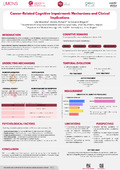
[en] Cancer-Related Cognitive Impairment (CRCI) is a consequence of cancer and its treatments, affecting a substantial proportion of the growing survivor population. CRCI encompasses deficits in cognitive functioning, with prevalence estimates ranging from 23% to 44%.
Beyond its neurobiological underpinnings, CRCI carries clinical and psychosocial consequences. Cognitive difficulties co-occur with anxiety, depression, and fatigue, forming a cluster of "invisible" symptoms that profoundly disrupts survivors' daily functioning. Return to work is often delayed or compromised, and the erosion of cognitive abilities contributes to diminished quality of life, loss of occupational identity, and increased psychological distress.
Disciplines :
Oncology
Author, co-author :
Henriette, Léa ; Université de Mons - UMONS > Faculté de Médecine, Pharmacie et Sciences Biomédicales > Service de Médecine computationnelle et Neuropsychiatrie
Richard, Vincent ; Université de Mons - UMONS > Faculté de Médecine et de Pharmacie > Sémiologie et Médecine générale ; HELORA > Oncologie médicale
Briganti, Giovanni ; Université de Mons - UMONS > Faculté de Médecine et de Pharmacie > Service de Médecine computationnelle et Neuropsychiatrie
Language :
English
Title :
Cancer-Related Cognitive Impairment: Mechanisms and Clinical Implications
Publication date :
17 March 2026
Event name :
Researcher's Tuesday
Event organizer :
Université de Mons et Université Polytechnique Hauts-de-France