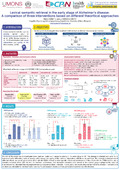
Lexical-semantic retrieval in the early stage of Alzheimer’s disease: A comparison of three interventions based on different theoritical approaches - 2026
[en] Objectives: Patients with Alzheimer's disease (AD) experience early lexical-semantic difficulties, such as anomia, which impact their ability to interact socially and their quality of life. This research aims to investigate the benefits of three treatment methods based on different theoretical approaches: the Elaborated Semantic Feature Analysis (ESFA) method, derived from semantic network models; the Treatment by Embodied Reactivation of Memory (TERM), based on the theory of embodied cognition; and the Holistic Intervention of Semantic Memory (HOLISM), built on the hub-and-spoke model.
Methods: Twenty-nine patients in the early stage of AD were recruited (MMSE ≥20) and divided into three groups: ESFA (N=10), TERM (N=9), and HOLISM (N=10). A four-phase experimental design was followed: pretest (A; 3 weeks), intervention (B; 8 weeks), posttest (A; 1 week), follow-up (A; 1 week). During phases A, patients attended two sessions per week for cognitive assessment based on episodic memory task, lexical-semantic tasks including an experimental naming task, executive function task, and speech task. During the intervention phase, patients attended two individual sessions per week. Some of the concepts that they failed to name in the pretest experimental naming task were then
trained using the respective methods. Results: Initial results from the comparison of the three assessment phases (A) indicate improvements in naming in all groups (ESFA: χ²(2) = 19.538, p<.001; TERM: χ²(2) = 7.588, p = .023; HOLISM: χ²(2) = 13.282, p = .001). At this stage, the generalization of effects to other untrained concepts seems to occur only with the ESFA method (χ²(2) = 6.222; p = .045) (data collection in progress for HOLISM).
Conclusions: The three methods appear to have different therapeutic effects. The results will be interpreted and discussed in the context of theoretical approaches.
Disciplines :
Theoretical & cognitive psychology
Author, co-author :
Semiz, Melike ; Université de Mons - UMONS > Faculté de Psychologie et des Sciences de l'Education > Service de Psychologie cognitive et Neuropsychologie
Simoes Loureiro, Isabelle ; Université de Mons - UMONS > Faculté de Psychologie et des Sciences de l'Education > Service de Psychologie cognitive et Neuropsychologie
Language :
English
Title :
Lexical-semantic retrieval in the early stage of Alzheimer’s disease: A comparison of three interventions based on different theoritical approaches