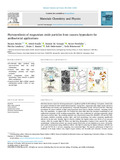
[en] Infectious diseases caused by microorganisms pose a significant public health challenge. In response, metal oxide have gained attention for their antimicrobial properties. Among these, magnesium oxide (MgO) stands out due to its effectiveness, low toxicity, and classification as “Generally Recognized As Safe” (GRAS) by the FDA. This study investigates the green synthesis of MgO using byproducts from cassava ( Manihot esculenta )—including starch, fiber, and manipueira—as organic fuels. We evaluate how these fuels affect the structural, morphological, and antibacterial properties of the resulting nanoparticles. MgO were synthesized by calcining magnesium nitrate with cassava-derived fuels. The resulting materials were characterized using XRD, SEM-EDX, XPS and BET-BJH. All samples exhibited crystalline periclase MgO, with both morphology and surface properties significantly affected by the fuel used. Notably, MgO-St (Starch) exhibited the highest surface area (50.56 m2/g) and pore volume, while the samples MgO-Fb (Fiber) and MgO-Mnp (Manipueira) displayed lower porosity but unique morphologies. Antibacterial activity was assessed against Escherichia coli and Staphylococcus aureus . All synthesized oxides demonstrated strong inhibitory effects, with MgO-St achieving the highest efficiency (98.96% for E. coli and 99.79% for S. aureus ), surpassing even commercial MgO. The superior performance of MgO-St is attributed to its larger surface area, higher oxygen content, and favorable pore structure. Overall, cassava byproducts have proven to be effective and eco-friendly fuels for MgO synthesis. These findings highlight MgO's potential as a sustainable antimicrobial agent for food and water safety applications, reinforcing its role in combating microbial contamination.
Disciplines :
Chemistry
Author, co-author :
Balaba, Nayara ; Chimie des Interactions Plasma-Surface (ChIPS), Research Institute for Materials Science and Engineering, University of Mons, Mons, Belgium ; Department of Chemistry, Universidade Estadual Do Centro-Oeste, UNICENTRO, Guarapuava, Brazil
Gualle, Arleth ; Chimie des Interactions Plasma-Surface (ChIPS), Research Institute for Materials Science and Engineering, University of Mons, Mons, Belgium
De Campos, Daniele ; Chimie des Interactions Plasma-Surface (ChIPS), Research Institute for Materials Science and Engineering, University of Mons, Mons, Belgium
Noirfalise, Xavier; Chimie des Interactions Plasma-Surface (ChIPS), Research Institute for Materials Science and Engineering, University of Mons, Mons, Belgium
Landercy, Nicolas; Chimie des Interactions Plasma-Surface (ChIPS), Research Institute for Materials Science and Engineering, University of Mons, Mons, Belgium
Anaissi, Fauze J. ; Department of Chemistry, Universidade Estadual Do Centro-Oeste, UNICENTRO, Guarapuava, Brazil
Onderwater, Rob; Chimie des Interactions Plasma-Surface (ChIPS), Research Institute for Materials Science and Engineering, University of Mons, Mons, Belgium
Bittencourt, Carla ; Université de Mons - UMONS > Faculté des Sciences > Service de Chimie des Interactions Plasma-Surface
Language :
English
Title :
Phytosynthesis of magnesium oxide particles from cassava byproducts for antibacterial applications
R400 - Institut de Recherche en Science et Ingénierie des Matériaux
Funders :
Araucaria Foundation Coordenação de Aperfeiçoamento de Pessoal de Nível Superior National Council for Scientific and Technological Development National Council for Scientific and Technological Development
Funding text :
Balaba appreciates Capes for a graduate scholarship. Anaissi is thankful for a CNPq Productivity grant (310815/2022-3) and the grants CNPq ( 427127 /2018-1). Anaissi and Bittencourt are thankful for a WBI/Confap-Funda\u00E7\u00E3o Arauc\u00E1ria (BEL2023081000001).
Baral, B.; Mamale, K.; Gairola, S.; Chauhan, C.; Dey, A.; Kaundal, R.K. Infectious Diseases and Its Global Epidemiology. In Nanostructured Drug Delivery Systems in Infectious Disease Treatment; Elsevier, 2024; pp. 1-24.
Jagirdhar, G.S.K.; Pulakurthi, Y.S.; Chigurupati, H.D.; Surani, S. Gastrointestinal Tract and Viral Pathogens. World J. Virol. 2023, 12, 136-150, doi:10.5501/wjv.v12.i3.136.
Mosaka, T.B.M.; Unuofin, J.O.; Daramola, M.O.; Tizaoui, C.; Iwarere, S.A. Inactivation of Antibiotic-Resistant Bacteria and Antibiotic-Resistance Genes in Wastewater Streams: Current Challenges and Future Perspectives. Front. Microbiol. 2023, 13, doi:10.3389/fmicb.2022.1100102.
Abbas, S.F.; Haider, A.J.; Al-Musawi, S.; Selman, M.K. Antibacterial Effect of Copper Oxide Nanoparticles Prepared by Laser Production in Water Against Staphylococcus Aureus and Escherichia Coli. Plasmonics 2024, 19, 2401-2411, doi:10.1007/s11468-023-02135-x.
Abo-zeid, Y.; Williams, G.R. The Potential Anti-infective Applications of Metal Oxide Nanoparticles: A Systematic Review. WIREs Nanomedicine and Nanobiotechnology 2020, 12, doi:10.1002/wnan.1592.
Ezzat, S.M.; Moustafa, M.T. Efficient Removal of E. Coli from Wastewater by Novel Phytofabricated Nano-Zinc Using Antibacterial Potential, Kinetic Studies, and Response Surface Methodology. Appl. Water Sci. 2024, 14, 80, doi:10.1007/s13201-024-02140-3.
Karthik, K.; Dhanuskodi, S.; Gobinath, C.; Prabukumar, S.; Sivaramakrishnan, S. Fabrication of MgO Nanostructures and Its Efficient Photocatalytic, Antibacterial and Anticancer Performance. J. Photochem. Photobiol. B 2019, 190, 8-20, doi:10.1016/j.jphotobiol.2018.11.001.
Umaralikhan, L.; Jamal Mohamed Jaffar, M. Green Synthesis of MgO Nanoparticles and It Antibacterial Activity. Iran. J. Sci. Technol. Trans. A Sci. 2018, 42, 477-485, doi:10.1007/S40995-016-0041-8/TABLES/3.
Codex Alimentarius Commission Codex General Standard for Food Additives (GSFA) Online Database: Updated up to the 42nd Session of the Codex Alimentarius Commission. . 2019.
Nazem, A.; Shaala, E.; Awad, S. Application of Some Inorganic Metal Oxide Nanoparticles to Control E. Coli in Raw Milk. Open Vet. J. 2024, 14, 545, doi:10.5455/OVJ.2024.v14.i1.49.
Bhoi, H.; Tiwari, S.; Manisha; Salvi, V.K.; Seal, P.; Modi, S.K.; Lal, G.; Mange, P.L.; Saharan, V.; Borah, J.P.; et al. Sustainable Synthesis of MgO NSs Using Natural Products for Enriching Structural, Optical, Magnetic & Hyperthermic Response and Their Impact against Microbes & Breast Cancer Cells. Mater. Chem. Phys. 2025, 346, 131332, doi:10.1016/j.matchemphys.2025.131332.
Yoon, J.Y.; Yeom, W.; Kim, H.; Beuchat, L.R.; Ryu, J.-H. Effects of Temperature, PH and Sodium Chloride on Antimicrobial Activity of Magnesium Oxide Nanoparticles against E. Coli O157:H7. J. Appl. Microbiol. 2022, 133, 2474-2483, doi:10.1111/jam.15719.
Mori, H.; Tack, J.; Suzuki, H. Magnesium Oxide in Constipation. Nutrients 2021, 13, 421, doi:10.3390/nu13020421.
Balaba, N.; Horsth, D.F.L.; Correa, J. de S.; Primo, J. de O.; Jaerger, S.; Alves, H.J.; Bittencourt, C.; Anaissi, F.J. Eco-Friendly Polysaccharide-Based Synthesis of Nanostructured MgO: Application in the Removal of Cu2+ in Wastewater. Materials 2023, 16, 1-15, doi:10.3390/ma16020693.
Hornak, J. Synthesis, Properties, and Selected Technical Applications of Magnesium Oxide Nanoparticles: A Review. Int. J. Mol. Sci. 2021, 22, 12752, doi:10.3390/ijms222312752.
Praipipat, P.; Ngamsurach, P.; Noisri, J.; Aeamsa-ard, T. The Low-Cost Biosorbents of Mangosteen (Garcinia Mangostana Linn) Doped Magnesium Oxide and Titanium Dioxide Beads for Eliminating Methylene Blue Dye. S. Afr. J. Chem. Eng. 2025, 51, 202-212, doi:10.1016/j.sajce.2024.11.008.
Jegadeeswari A; Nivetha S Synthesis and Characterization of Magnesium Oxide Nanoparticles by Sol-Gel Method. Nanoscale Reports 2020, 3, 12-15, doi:10.26524/nr.3.19.
Todan, L.; Predoana, L.; Petcu, G.; Preda, S.; Culița, D.C.; Baran, A.; Trusca, R.D.; Surdu, V.A.; Vasile, B. Ștefan; Ianculescu, A.C. Comparative Study of MgO Nanopowders Prepared by Different Chemical Methods. Gels 2023, 9, doi:10.3390/gels9080624.
Essien, E.R.; Atasie, V.N.; Okeafor, A.O.; Nwude, D.O. Biogenic Synthesis of Magnesium Oxide Nanoparticles Using Manihot Esculenta (Crantz) Leaf Extract. Int. Nano Lett. 2020, 10, 43-48, doi:10.1007/s40089-019-00290-w.
Okrathok, S.; Thumanu, K.; Pukkung, C.; Molee, W.; Khempaka, S. Extraction of Dietary Fibers from Cassava Pulp and Cassava Distiller’s Dried Grains and Assessment of Their Components Using Fourier Transform Infrared Spectroscopy to Determine Their Further Use as a Functional Feed in Animal Diets. Anim. Biosci. 2022, 35, 1048-1058, doi:10.5713/ab.21.0430.
Silva, A.P.R. e; Pantoja, G.V.; Crispino, A.C.S.; Braga, Y.P.; Lima, M.F.T.; Silva, L.F.; Rodrigues, E.A.L.; De Oliveira, J.A.R. Tucupi: A Review of Uses, Physical-Chemical, Nutritional Properties and Technologies. Brazilian Journal of Development 2023, 9, 17467-17487, doi:10.34117/bjdv9n5-199.
Brito, B. de N. do C.; Martins, M.G.; Chiste, R.C.; Lopes, A.S.; Gloria, M.B.A.; Pena, R. da S. Total and Free Hydrogen Cyanide Content and Profile of Bioactive Amines in Commercial Tucupi, a Traditionally Derived Cassava Product Widely Consumed in Northern Brazil. Foods 2023, 12, 4333, doi:10.3390/foods12234333.
Guo, L.; Lei, R.; Zhang, T.C.; Du, D.; Zhan, W. Insight into the Role and Mechanism of Polysaccharide in Polymorphous Magnesium Oxide Nanoparticle Synthesis for Arsenate Removal. Chemosphere 2022, 296, 133878, doi:10.1016/J.CHEMOSPHERE.2022.133878.
Primo, J. de O.; Bittencourt, C.; Acosta, S.; Sierra-Castillo, A.; Colomer, J.F.; Jaerger, S.; Teixeira, V.C.; Anaissi, F.J. Synthesis of Zinc Oxide Nanoparticles by Ecofriendly Routes: Adsorbent for Copper Removal From Wastewater. Front. Chem. 2020, 8, 1-13, doi:10.3389/fchem.2020.571790.
Bhattacharya, P.; Dey, A.; Neogi, S. An Insight into the Mechanism of Antibacterial Activity by Magnesium Oxide Nanoparticles. J. Mater. Chem. B 2021, 9, 5329-5339, doi:10.1039/D1TB00875G.
Minicurso, D.; Organismos, F.D.E.; Teoria, D.; Pratica, C.E. Numero Folha Livro DIREX-ON-2016 Professora Cacilda Marcia Duarte Rios Faria , Professora Elaine Maria Dos Santos ,. 2016, 16, 2016.pt
Rodriguez-Hernandez, A.-P.; Vega-Jimenez, A.L.; Vazquez-Olmos, A.R.; Ortega-Maldonado, M.; Ximenez-Fyvie, L.-A. Antibacterial Properties In Vitro of Magnesium Oxide Nanoparticles for Dental Applications. Nanomaterials 2023, 13, 502, doi:10.3390/nano13030502.
Khan, M.I.; Akhtar, M.N.; Ashraf, N.; Najeeb, J.; Munir, H.; Awan, T.I.; Tahir, M.B.; Kabli, M.R. Green Synthesis of Magnesium Oxide Nanoparticles Using Dalbergia Sissoo Extract for Photocatalytic Activity and Antibacterial Efficacy. Appl. Nanosci. 2020, 10, 2351-2364, doi:10.1007/s13204-020-01414-x.
Li, X.; Feng, Y.; Li, H.; Zhang, Q. Effect of Anionic Groups on the Antibacterial Activity of Magnesium Oxide Nanoparticles. Colloids Surf. A Physicochem. Eng. Asp. 2022, 635, 127978, doi:10.1016/j.colsurfa.2021.127978.
Nguyen, N.Y.T.; Grelling, N.; Wetteland, C.L.; Rosario, R.; Liu, H. Antimicrobial Activities and Mechanisms of Magnesium Oxide Nanoparticles (NMgO) against Pathogenic Bacteria, Yeasts, and Biofilms. Sci. Rep. 2018, 8, doi:10.1038/s41598-018-34567-5.
Bhoi, H.; Joshi, P.; Punia, K.; Lal, G.; Kumar, S. Synthesis and Rietveld Refinement of MgO Nanoparticles.; 2020; p. 020109.
Huang, L.; Yang, Z.; Wang, S. Influence of Calcination Temperature on the Structure and Hydration of MgO. Constr. Build. Mater. 2020, 262, 120776, doi:10.1016/j.conbuildmat.2020.120776.
Pineda De La O, E.; Alhazmi, N.; Ebbens, S.J.; Dunbar, A.D.F. Influence of Additives on the In Situ Crystallization Dynamics of Methyl Ammonium Lead Halide Perovskites. ACS Appl. Energy Mater. 2021, 4, 1398-1409, doi:10.1021/acsaem.0c02625.
Deepti Gupta; Trapti Gupta; Ramphal Sharma; Gunjan Soni Solution-Grown Transparent ZnS Ultra-Thin Nanostructured Films for Photocatalytic Degradation of Methyl Red. Journal of Nanoscience and Technology 2025, 10, 1006-1011, doi:10.30799/jnst.359.25100301.
Thermo Fisher Scientific Magnesium X-Ray Photoelectron Spectra, Magnesium Electron Configuration, and Other Elemental Information.
Velmurugan, A.; Warrier, A.R. Production of Biodiesel from Waste Cooking Oil Using Mesoporous MgO-SnO2 Nanocomposite. Journal of Engineering and Applied Science 2022, 69, 92, doi:10.1186/s44147-022-00143-y.
Chatla, A.; Almanassra, I.W.; Kochkodan, V.; Laoui, T.; Alawadhi, H.; Atieh, M.A. Efficient Removal of Eriochrome Black T (EBT) Dye and Chromium (Cr) by Hydrotalcite-Derived Mg-Ca-Al Mixed Metal Oxide Composite. Catalysts 2022, 12, 1247, doi:10.3390/catal12101247.
de Tombeur, F.; Roux, P.; Cornelis, J.-T. Silicon Dynamics through the Lens of Soil-Plant-Animal Interactions: Perspectives for Agricultural Practices. Plant Soil 2021, 467, 1-28, doi:10.1007/s11104-021-05076-8.
Sanchez-Zambrano, K.S.; Hernandez-Resendiz, M.; Gomez-Rodriguez, C.; Garcia-Quinonez, L.V.; Aguilar-Martinez, J.A.; Rodriguez-Castellanos, E.A.; Verdeja, L.F.; Fernandez-Gonzalez, D.; Castillo-Rodriguez, G.A. XPS Study on Calcining Mixtures of Brucite with Titania. Materials 2022, 15, 3117, doi:10.3390/ma15093117.
Krishna, D.N.G.; Philip, J. Review on Surface-Characterization Applications of X-Ray Photoelectron Spectroscopy (XPS): Recent Developments and Challenges. Applied Surface Science Advances 2022, 12, 100332, doi:10.1016/j.apsadv.2022.100332.
Kumar, R.; Adhikari, S.; Driver, E.M.; Smith, T.; Bhatnagar, A.; Lorkiewicz, P.K.; Xie, Z.; Hoetker, J.D.; Halden, R.U. Towards a Novel Application of Wastewater-Based Epidemiology in Population-Wide Assessment of Exposure to Volatile Organic Compounds. Science of The Total Environment 2022, 845, 157008, doi:10.1016/j.scitotenv.2022.157008.
Yin, Z.; Li, S.; Li, X.; Shi, W.; Wang, A.; Yu, C.; Shi, X.; Carroll, D.L.; Ma, C. Effect of PH on the Microstructure and Antibacterial Properties of MgO Nanoparticles by Microwave-Assisted Solution Combustion. J. Alloys Compd. 2024, 1009, 176858, doi:10.1016/j.jallcom.2024.176858.
Zhang, Y.; Shao, D.; Yan, J.; Jia, X.; Li, Y.; Yu, P.; Zhang, T. The Pore Size Distribution and Its Relationship with Shale Gas Capacity in Organic-Rich Mudstone of Wufeng-Longmaxi Formations, Sichuan Basin, China. Journal of Natural Gas Geoscience 2016, 1, 213-220, doi:10.1016/j.jnggs.2016.08.002.
Rahman, Md.M.; Shafiullah, A.Z.; Pal, A.; Islam, Md.A.; Jahan, I.; Saha, B.B. Study on Optimum IUPAC Adsorption Isotherm Models Employing Sensitivity of Parameters for Rigorous Adsorption System Performance Evaluation. Energies (Basel). 2021, 14, 7478, doi:10.3390/en14227478.
Borgohain, X.; Boruah, A.; Sarma, G.K.; Rashid, Md.H. Rapid and Extremely High Adsorption Performance of Porous MgO Nanostructures for Fluoride Removal from Water. J. Mol. Liq. 2020, 305, 112799, doi:10.1016/j.molliq.2020.112799.
Thommes, M.; Kaneko, K.; Neimark, A. V.; Olivier, J.P.; Rodriguez-Reinoso, F.; Rouquerol, J.; Sing, K.S.W. Physisorption of Gases, with Special Reference to the Evaluation of Surface Area and Pore Size Distribution (IUPAC Technical Report). Pure and Applied Chemistry 2015, 87, 1051-1069, doi:10.1515/pac-2014-1117.
Song, G.; Zhu, X.; Chen, R.; Liao, Q.; Ding, Y.-D.; Chen, L. Influence of the Precursor on the Porous Structure and CO 2 Adsorption Characteristics of MgO. RSC Adv. 2016, 6, 19069-19077, doi:10.1039/C5RA26595A.
Naren Vidaarth, T.M.; Surendhiran, S.; Jagan, K.S.G.; Savitha, S.; Balu, K.S.; Karthik, A.; Kalpana, B. Surface Chemistry of Phytochemical Enriched MgO Nanoparticles for Antibacterial, Antioxidant, and Textile Dye Degradation Applications. J. Photochem. Photobiol. A Chem. 2024, 448, 115349, doi:10.1016/j.jphotochem.2023.115349.
Wang, Y.; Xiao, D.; Hu, L.; Li, Z.; Li, Z.; Duan, K.; He, K. Antibacterial Effects of Magnesium Oxide, Related Mechanisms, and Prospective Applications for Reducing Orthopaedic Implant-Related Infections. Magnes. Res. 2025, 38, 00-00, doi:10.1684/mrh.2025.0543.
Bhoi, H.; Tiwari, S.; Lal, G.; Jani, K.K.; Modi, S.K.; Seal, P.; Saharan, V.; Modi, K.B.; Borah, J.P.; Punia, K.; et al. Green Synthesis and Characterization of Mg0.93Na0.07O Nanoparticles for Antimicrobial Activity, Cytotoxicity and Magnetic Hyperthermia. Ceram. Int. 2022, 48, 28355-28373, doi:10.1016/j.ceramint.2022.06.146.
Rotti, R.B.; Sunitha, D. V.; Manjunath, R.; Roy, A.; Mayegowda, S.B.; Gnanaprakash, A.P.; Alghamdi, S.; Almehmadi, M.; Abdulaziz, O.; Allahyani, M.; et al. Green Synthesis of MgO Nanoparticles and Its Antibacterial Properties. Front. Chem. 2023, 11, doi:10.3389/fchem.2023.1143614.
Hillman, T. Antibiotics, Efflux, and PH. Arch. Proteom. Bioinform. 2023, 3, 15-18, doi:10.33696/Proteomics.3.013.
Alnehia, A.; Alnahari, H.; Al-Sharabi, A. Characterization and Antibacterial Activity of MgO/CuO/Cu2MgO3 Nanocomposite Synthesized by Sol-Gel Technique. Results Chem. 2024, 8, 101620, doi:10.1016/j.rechem.2024.101620.
He, Y.; Ingudam, S.; Reed, S.; Gehring, A.; Strobaugh, T.P.; Irwin, P. Study on the Mechanism of Antibacterial Action of Magnesium Oxide Nanoparticles against Foodborne Pathogens. J. Nanobiotechnology 2016, 14, 54, doi:10.1186/s12951-016-0202-0.
Akshaykranth, A.; Jayarambabu, N.; Tumu, V.R.; Rajaboina, R.K. Comparative Study on Antibacterial Activity of MgO Nanoparticles Synthesized from Lawsonia Inermis Leaves Extract and Chemical Methods. J. Inorg. Organomet. Polym. Mater. 2021, 31, 2393-2400, doi:10.1007/s10904-021-01915-4.
Li, X.; Hong, X.; Yang, Y.; Zhao, J.; Diko, C.S.; Zhu, Y. Enhanced Antibacterial Activity of Acid Treated MgO Nanoparticles on Escherichia Coli. RSC Adv. 2021, 11, 38202-38207, doi:10.1039/D1RA06221B.
Kumari, S.V.G.; Pakshirajan, K.; Pugazhenthi, G. Synthesis and Characterization of MgO Nanostructures: A Comparative Study on the Effect of Preparation Route. Mater. Chem. Phys. 2023, 294, 127036, doi:10.1016/j.matchemphys.2022.127036.
Thamizharasan, S.; Gurunathan, K.; Varaprasad, K.; Chandrasekaran, K. Green Engineering of MgO Nanoparticles: Assessment of Their Antioxidant and Antibacterial Activity against Dental Pathogens. Inorg. Chem. Commun. 2024, 169, 113025, doi:10.1016/j.inoche.2024.113025.
Iskandar, K.; Pecastaings, S.; LeGac, C.; Salvatico, S.; Feuillolay, C.; Guittard, M.; Marchin, L.; Verelst, M.; Roques, C. Demonstrating the In Vitro and In Situ Antimicrobial Activity of Oxide Mineral Microspheres: An Innovative Technology to Be Incorporated into Porous and Nonporous Materials. Pharmaceutics 2023, 15, 1261, doi:10.3390/pharmaceutics15041261.
Bouras, D.; Fellah, M.; Salhi, B.; Ankah, N.; Merah, N. Tailoring Porosity and Antibacterial Activity in MgO/ZrO2-Modified Kaolin Ceramics for Use in Wastewater Filtration Systems. Journal of Science: Advanced Materials and Devices 2025, 10, 100974, doi:10.1016/j.jsamd.2025.100974.