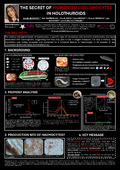
[en] Cœlomocytes are known to be circulating cells within cœlomic cavities, and to play a role in the immune response in
different invertebrates including holothuroids, also known as sea cucumbers (Echinodermata). Among the various types
of cœlomocytes, haemocytes are distinguished by their intense red pigmentation, which has been attributed to the
presence of intracellular haemoglobin for over a century. In contrast to other cœlomocytes found in the hydrovascular
and perivisceral fluids, haemocytes circulate exclusively in the hydrovascular fluid or are associated with internal organs
membranes. The presence of haemoglobin indicated a potential role in oxygen transport, which could be particularly
valuable for endobenthic species. However, our research on the haemocytes of Holothuria forskali revealed unexpected
carotenoid concentrations instead of haemoglobin in this European epibenthic species. These findings led us to rename
those cells as "carotenocytes" and to propose that they may act as immune regulators thanks to their antioxidant
properties. This study focuses on the localization of carotenocytes and their pigments within the various tissues of
holothuroids, with the objective of providing insight into their site of production and action. Furthermore, the aim is to
extend the investigation into the pigment origin and the role of carotenocytes in diverse sea cucumber species of varying
taxonomy and ecology. The study has already demonstrated the presence of carotenoids in the haemal system of H.
forskali, which is otherwise populated by pigmented cœlomocytes. Moreover, similar carotenoids have been identified
in the Polian vesicle (a hydrostatic organ filled with hydrovascular fluid) of the tropical species H. atra. In conclusion,
our studies support the hypothesis that the red pigmentation of pigmented cœlomocytes has been incorrectly
associated with haemoglobin across all holothuroids, or at least in certain species.
Disciplines :
Aquatic sciences & oceanology
Author, co-author :
Bossiroy, Estelle ; Université de Mons - UMONS > Faculté des Sciences > Service de Biologie des Organismes Marins et Biomimétisme
Wambreuse, Noé ; Université de Mons - UMONS > Faculté des Sciences > Service de Biologie des Organismes Marins et Biomimétisme
Frank, David; Station Marine de Concarneau > Museum National d’Histoire Naturelle (MNHN) > Déléguée à la Recherche, l'Expertise, la Valorisation et l'Enseignement (DGD REVE)
Mussoi, Lisa ; Université de Mons - UMONS > Faculté des Sciences > Service de Biologie des Organismes Marins et Biomimétisme
Gerbaux, Pascal ; Université de Mons - UMONS > Faculté des Sciences > Service de Synthèse et spectrométrie de masse organiques
Eeckhaut, Igor ; Université de Mons - UMONS > Faculté des Sciences > Service de Biologie des Organismes Marins et Biomimétisme
Caulier, Guillaume ; Université de Mons - UMONS > Faculté des Sciences > Service de Biologie des Organismes Marins et Biomimétisme
Language :
English
Title :
The secret of pigmented cœlomocytes in holothuroids
Alternative titles :
[fr] Le secret des cœlomocytes pigmentés chez les holothuries
Publication date :
05 March 2025
Event name :
VLIZ Marine Science Day,
Event place :
Bruges, Belgium
Event date :
12 septembre 2023
Peer review/Selection committee :
Editorial reviewed
Research unit :
S864 - Biologie des Organismes Marins et Biomimétisme