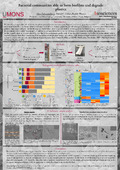
[en] Because of its essential role in human life, plastic production increases every year. Most plastics are released in landfills and end up in the sea. Scientists estimate that 5 trillion of plastic pieces (macro and micro particles) are present in the marine environment [1]. These synthetic polymers cause large ecological and health impacts [2]. However, some microorganisms are able to grow on plastic and some bacteria are even able to degrade it. In this research, bacterial communities from marine plastics (Mediterranean Sea, Corsica) and from a wastewater treatment plant (Wasmüel, Belgium) were analysed by 16S rRNA sequencing and by a DGGE (denaturing gradient gel electrophoresis) approach. We also enriched plastic-degrading bacteria using cultivation media with low carbon contents, in the presence of plastic fragments. Plastic used were the four most important polymers produced in Europe: Low Density PolyEthylene (LDPE), PolyEthylene Terephthalate (PET), PolyStyrene (PS) and PolyVinyl Chloride (PVC). After 2 months of cultivation, two bacterial strains were enriched for the marine samples on LDPE: Alkanivorax borkumensis and Microbulbifer sp. The first bacterium is already known for its ability to degrade hydrocarbon chains and the second one for its complex polysaccharide degradation. Therefore, these bacteria are potential candidates for LDPE degradation. The structure of the biofilm and biodegradation marks were observed on plastic surfaces by scanning electron microscopy (SEM). Holes and cracks were observed on several samples. For the biofilms formed with the wastewater treatment samples, a large richness was observed and SEM revealed signs of degradation on the 4 types of plastics.