Acid solutions; Belgian Blue Stone; Stone-cutting finishes; Acidic Reaction; Alteration Kinetics; Surface Roughness; Surface Area
Abstract :
[en] Stone-cutting marks left on architectural stones are essential for preserving the authenticity of craftsmanship. These surface finishes, tangible witnesses of historical events, traditional construction practices and tooling techniques, embody cultural and technical aspects of intangible heritage.
Although stone is traditionally considered as a durable and permanent, it is not immune to deterioration and undergoes irreversible physico-chemical deterioration caused by environmental interactions. The Nara Document on Authenticity (1994) acknowledges that both natural and anthropogenic material alterations is part of the monuments’ authenticity as well as the material itself, even if the most delicate aesthetic details gradually fade over time. The increasing impact of climate change, including acid rain and pollution, accelerates stone decay, raising concerns about heritage preservation. Acidic compounds from environmental and anthropogenic sources, like acid rain, maintenance products or biological colonisation, significantly contribute to limestone deterioration.
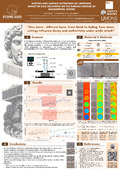
This study investigates the alteration of the Belgian Blue Stone, widely used in Belgian architectural heritage, under the influence of acidic conditions, focusing on three common surface finishes. Laboratory simulations assess weathering kinetics and material loss, initially assessing exposure to household acids to develop a controller system and refine the protocol. 3D optical profilometry quantifies surface roughness and specific surface areas. On saw-cut surfaces, the dissolution of the calcite matrix exposes fossils, increasing roughness, whereas initially rougher surface finishes (pitted, Antique) evolve differently. Comparing exposed and unexposed surface finishes using controller system provides insights into the long-term degradation processes and evolution of roughness, the role of initial texture and deterioration kinetics.
Descamps, Fanny ; Université de Mons - UMONS > Faculté Polytechnique > Service de Génie Minier
Debailleux, Laurent ; Université de Mons - UMONS > Faculté Polytechnique > Service de Génie Architectural et Urbain
Speaker :
Fanfone, Morgane ; Université de Mons - UMONS > Faculté Polytechnique > Service de Génie Architectural et Urbain
Language :
English
Title :
Kinetics and Surface Alteration of Limestone: Impact of Acid Solutions on the Surface Finishes of Monumental Stones
Alternative titles :
[fr] Cinétique d'altération et altération superficielle de pierre calcaire : Impact de solutions acides sur des finitions de taille superficielles des pierres monumentales
Publication date :
10 September 2025
Event name :
15th International Congress on the Deterioration and Conservation of Stone
Event organizer :
Julie DESARNAUD (KIK-IRPA : Institut royal du Patrimoine artistique) Beatriz MENENDEZ (Cergy Paris Université) Philippe BROMBLET (CICRP : Centre Interdisciplinaire de Conservation et Restauration du Patrimoine) Jérémie BERTHONNEAU (CICRP : Centre Interdisciplinaire de Conservation et Restauration du Patrimoine) Lise LEROUX (LRMH : Laboratoire de Recherche des Monuments Historiques) Jérémy HENIN (LRMH : Laboratoire de Recherche des Monuments Historiques) Gaïa JUNGEBLOLDT (ICOMOS international : Conseil International des Monuments et des Sites) Laurence LE CALLONNEC (Sciences Sorbonne Université / ISTeP Sorbonne Université-CNRS)
Event place :
Paris, France
Event date :
8-12 septembre 2025
Event number :
15
Audience :
International
Peer review/Selection committee :
Peer reviewed
Development Goals :
11. Sustainable cities and communities
Research unit :
F803 - Génie Architectural et Urbain F408 - Génie Minier
Research institute :
R400 - Institut de Recherche en Science et Ingénierie des Matériaux R500 - Institut des Sciences et du Management des Risques